Saturday, January 9, 2010

Book Review: "How to Play Better Tennis", Bill Tilden (1950)

New Year 2010 is the 60th year anniversary of Bill Tilden's classic book, first published in 1950, How to Play Better Tennis: A Complete Guide to Technique and Tactics, (Simon & Schuster, Inc., 1950)(reprinted in 1973 by Cornerstone Library, and republished in 2000 by Simon & Schuster.) (See Link on Amazon to Kindle version.)

Tilden wrote the book at the close of his record-setting career, having been voted by the Associated Press Sportwriters of America as the "Greatest Player of Half-Century". He meant the book to provide insights and concepts distilled from a half-century career in tennis.

In his foreword to the book, he remarked: "This book is intended for tennis players... If you are one of the real tennis nuts - and they are legion - this is written for you in the hope that it may fill a real want... If from its pages one player learns something of value that will lift him from just a person who hits a tennis ball to that very different status - a tennis player - I am indeed rewarded."

Six decades after its publication, and even after monumental changes in the sport, the book still surprisingly retains valuable teachings still relevant to today's player and game...The book is divided into 4 Parts and 18 Chapters. It covers tennis foundations, strokes and their uses, match play tactics and psychology and some conclusions, with black and white illustrations and examples. In the words of the publisher in 1973, each chapter is a lesson from the Master himself.

New York Times sportswriter Allison Danzig wrote in 1973: "William Tilden has no superior in lawn tennis as a master of stroke production and tactics. His command of spin and pace, his knowledge of the game and his footwork have never been surpassed...[The book] is as pertinent, commands just as much respect and should be every bit as helpful, as was the book when first published in 1950." The same could largely be said today.

The best way to review this book is to quote extensively from Tilden himself on various relevant tennis topics. You are invited to read the entire book for much more detail about his ideas in his interesting writing style...

On Playing Tennis
"I urge you - Play Tennis! Tennis the most valuable sport that any individual can learn...It is the most universally played of all athletics and its rules are the same the world over...Language is no barrier to tennis players, since whether a ball is out or in can be seen and understood without spoken words. Tennis, by its small requirements of time and playing space, and it comparatively inexpensive equipment, lies within the reach of practically everyone. The tremendous increase in public courts in almost all cities has taken the game away from the classes and put it in the hands of the masses, which is a healthy and splendid thing in every way."

On the Game of Tennis"There is nothing mysterious about tennis. It is a game of sound, scientific principles, that anyone with an average mind and body can learn to play well if he will take the trouble to work at it."

On Tennis and Fitness
"The greatest benefit that tennis gives its followers is the means to keep physically fit. It is a game that can be played practically from the cradle to the grave - and it is apt to aid in postponing the latter many years...It is a game that can be carried on along with practically any form of human endeavor. The businessman, doctor, lawyer, actor, singer, writer, etc. are all able to find enough leisure time to play, and by so doing, increase their productivity by better physical condition."

On Learning from History and Past Champions
"The champion of today owes his game to the champions of yesterday, just as he will add his bit to the champion of tomorrow. The wise student should know all he can about the styles and methods of the great players of the past, every bit as much as he does of the players of the present."

On the Importance of Racquet Head Control
"[The] all-important fact...is the head of the racquet and only the head of the racquet returns a ball in tennis...Power - speed and pace- is controlled completely by the manner in which the head of the racquet is swung against the ball in hitting it...The player who will always have his racquet head hit the ball solidly and travel directly into and through the line of his shot will always have complete control of his strokes...The greatest tennis motto I know is: "Let your racquet head do the work".

On the Mind's Intention Behind the Shot"Tennis should always be played with the head consciously directing the racquet. Every shot should be played with a definite intention behind it, one that will make it of value to the player that hits it."

On What is a Tennis Player?"The viewpoint on tennis that stamps a tennis player is that the game is a science and an art. It can reach its highest expression only if a player can study and practice in an effort to master the game in all its varied facets...Remember always that even more can be learned in defeat than in victory, if you suffered that defeat when you gave your best."


On Footwork"The reason that correct footwork is so vital to good stroke production is that correct footwork furnishes an automatic way to bring the racquet head into a position to hit directly into and through the line of the stroke...One universal feature is to be found in the games of all great players...They never seem to be hurried...Watching [them], one gains the impression that they glide or float to the ball."


On Concentration"The first great fundamental of tennis is to train yourself to concentrate so that you never stop concentrating while on the court. This applies when you are learning the technique of the game, when practicing shots, or playing in practice, but above all, when playing matches."


On Shot Preparation"The great player prepares his shot on the way to it, while the lesser player starts to prepare it when he reaches the ball."

On Strokes"Strokes are the weapons with which you fight your tennis battles. The better your weapons, the greater the chance of victory. Still you must remember that weapons alone never won a war. It is the way in which they are used that determines their usefulness...[they] are not the end, but a means to an end...never be satisfied to be just a shot-maker..."

On the Net Game"The net game - the volley and overhead smash - represents the ultimate attack in tennis. It is the crushing offensive that either blasts the opponent off the court or wrecks itself by the very fury of its own attack."

On Courage in Tennis"Courage embodies patience, philosophy, and the vision, to lift your eyes to the goal far ahead. It is the ability, in spite of discouragement, disheartening disappointments, even apparent failure, never to lose sight of the goal, or belief in yourself and your ultimate victory."

On Match Play and Tennis Psychology"Keep the ball in play and give your opponent another shot at it...Play a defensive game with an offensive mental attitude...Never give your opponent a shot he likes to play if you can avoid it...Never change a winning game...Always change a losing game...


On the Ideas and Philosophy in the Book"I am hoping that [they help] contribute to the return of the balanced, intelligent game. [If so], I can feel it is the climax to my tennis, and can lay down my racquet with a sense of complete contentment and fulfillment."

Best Wishes!
Gary

Thursday, December 24, 2009

Want some tennis inspiration?


                   Courtesy: Omni Athlete 

Absorb this talk from Coach John Nelson of University of Hawaii (retired), 26 years coaching, third degree black belt in Jujitsu . . . Art of Winning . . . finding a solution . . . staying in the moment . . . using discipline and training to overcome fear . . . 

Tennis is like the martial arts . . . 
Being centered, balanced, disciplined . . . 
Low to the ground . . .
Power comes from the ground up . . .
Your mind is your biggest weapon . . .

It's like success in life . . .
It's about daily hard work . . . discipline . . . responding under pressure . . . facing your fears . . . problem-solving . . . and there's a solution to every problem . . . you are a student every day learning . . . as you get better, just simplify and make it simple, clean, smooth . . . 

Indeed, tennis is a metaphor for life . . . it's about on-court heroics . . . overcoming obstacles, barriers, injuries, setbacks . . . battling against the odds . . . formulating a game plan and then executing it to victory. 

Book Review: "Open: An Autobiography", Andre Agassi

"Open" is a Disappointment
I recently completed reading Eight-time Grand Slam winner Andre Agassi's highly publicized autobiography with some of those shocking revelations about recreational drug use and lying to tennis authorities about it.

Frankly, I was disappointed.

Although I have great respect for Agassi's on-court accomplishments and skills, his magnificent work for charity and the sport, and his commentator's insights into the game, I have diminished respect for some of his off-court actions over the years. And to some degree what he has admitted to in his book, and in follow-up interviews, leaves an unpleasant cloud over the sport, coming from a player with his stellar record - a record which to some extent has also been tainted.

Others have commented about how we as a society should probably not idolize sports stars. Indeed, I could not agree more that flaws, faults and failings of top stars should not be swept under the rug; rather, sports heroes have to be "called" on them, when necessary. They are, of course, only human like the rest of us, and at times need both compassion and help. Yet, we can still admire and exalt their on-court heroics without putting them on a pedestal and excusing their inexcusable actions.

In the book, Agassi comes across as a confused, lonely and depressed figure, driven to tennis by a hard-charging father, and equally demanding coaches. He, of course, grew to hate it. He turned to recreational drug use, it appears, in response to deepening depression.

Recreational drug use of a substance such as crystal meth, known as highly addictive, is not an acceptable option for depression, in my book. Agassi was wrong for taking that road, and should properly be "called" on it. The World Anti-Doping authorities and tennis federation also call it a banned substance, and he got away with it by using it and then by lying about it. Yes, we should be very compassionate, but that does not mean sweep it under the rug.

The proper option for people with clinical or other depression is get professional help.

Well, enough said.

As for the book itself, it essentially consists of 388 pages of first person "stream of consciousness" writing. The Chapters do not have descriptive headings, and there is no Table of Contents, no Index and no footnotes. There is no collection of color photos on photo paper in the book, as many other books offer such as Pete Sampras's book, A Champion's Mind.

In fact, there is not really much analysis of the game and sport of tennis. Maddeningly little, in my view.

I was hoping for many more insights and analysis of the game and sport of tennis, including topics such as tennis's growth, development and future, instruction and advice for young and up-and-coming players, and inside scoop into the pro game, and so on..A person with the caliber of his experience and accomplishments could have offered much more in that vein...

A lot of the "revealing" parts of the book seemed to consist of gripes and complaints about people in different parts of Agassi's life: Brooke Shields, Nick Bollettieri, Illie Nastase, Jimmy Connors. He did not have very nice things to say about these folks... He even goes out of his way to call Pete Sampras a cheap tipper at a restaurant. Page 346.

He uses profanity and four-letter words a lot in the book.

He basically agrees in calling Connors a certain part of the rear of a human's digestive anatomy (begins with "A".) Page 121.

And a lot of the self-discovery and personal journey he describes in the book, while quite sincere, reveals in my opinion a confused, lonely and depressed person, though with great professional accomplishments, who needed help.

And the biggest letdown of all for tennis fans: his admission that for many years he hated tennis with a dark and secret passion. Page 3.

In conclusion, the bottom line for me: It's an interesting read, but fell short of my expectations. The book - and the player too.

Friday, December 18, 2009

Tennis Self-Talk: Historical Examples and Solutions

"Losing is inevitable. But defeat is optional."

I. Introduction

It's been said that the mind is always with you or against you...Self-talk in us humans is instinctive, spontaneous and eternal. And perhaps so is our need for it.

In fact, one commentator remarked that if we opened up a person's head, we would see a popcorn machine full of thoughts and emotions endlessly popping, perculating and colliding. And it's no different in the game of tennis, as we all know.

II. Agassi's formulation of the dilemma
Compounding the problem is the fact that tennis, in singles play at least, is probably the most solitary of sports...

Eight-time Grand Slam winner, Andre Agassi put it this way in his recent autobiography and follow-up interviews:


"Tennis is the loneliest of sports. In golf, you play the course - plus you have a caddie - and the game ends at 18 holes. In boxing, you have a corner man and a set number of rounds.

In tennis, you're on an island, with no clock. You can't sit on a lead. You have to win the last point to win a match."

"But I will say this - I can confidently say that tennis is the loneliest sport that exists. You're out there, you can't talk to anybody, you can't pass the ball, there are no time-outs. There's no coaching, you don't have to be good, you have to be better than one person and that one person is on the other side of the net.

It's like you're on an island. It's not like boxing where we're leaning on each other and you can feel each other. If you look at a tennis player it's like solitary confinement out there, and what happens in solitary confinement? It always leads to self-talk.

You have those Lincoln-Douglas debates with yourself. You talk to yourself and you answer yourself and you tell me if you've ever seen another sport where an athlete talks to themselves as much as they do in tennis."
Andre Agassi
From "Open: An Autobiography" (2009),
and Interview with Travis Smiley, Nov. 19, 2009
How then do we deal with the loneliness of this sport? The eternal self-talk?


The endless conversation with ourselves about the score, about errors, about losing, about letting ourselves and others down, etc.

How do we defeat the toughest opponent of all - ourselves?

III. Searching for some answers
It seems obvious that we cannot change who and what we are as humans. Thus, the road to solution appears to point to the fact that we need to manage self-talk, just as we are called upon in life to manage daily stress and worry. Indeed, if we do not actively manage our self-talk, it will most likely end up managing us...

One researcher, the late Dorothy Harris, Ph.D., Professor of Sports Psychology at Penn State, put it this way: "The only difference between the best performance and the worst performance is the variation of our self-talk...and attitudes we carry around with us." So how do we manage our self-talk to better accomplish our "best performance"?

Perhaps some specific answers to this problem can be found in examples of others, in history and more recently, who have faced the issue. How have others at the highest level in tennis successfully dealt with the problem of self-talk? And can we try and model them? Can these examples help us to develop and implement an intelligent management strategy to address the problem of self-talk?

IV. A few examples and solutions
**Chris Evert and Diffusing Self-Talk -
Early in her career training, Chris Evert was taught by her father to diffuse any negative self-talk or body language. Any such verbal, or non-verbal clues, her father said, would only serve to motivate her opponent. In fact, he admonished that it was practically like handing your opponent a free point or two.

Chris admitted though, that like nearly all of us, she was bubbling with emotions and worries just under the surface. But she knew that for her temperament, she needed to find a consistent way to short-circuit whatever emotional self-talk she could in order to stay focused and stable with her relentless baseline game.

She in fact diffused her emotional self-talk so well that she was dubbed the "Ice Maiden", in a magnificent career spanning 18 Grand Slam titles and a stunning 90% career win-loss record.

**John McEnroe and Leveraging Self-Talk -
John McEnroe is probably the epitome of the volatile fiery player who successfully used his explosive rantings and angry outbursts to spur him on to a higher level of play (We all remember that catchphrase: "You cannot be serious!") .

In one sequence made famous in sports highlight reels, he explodes at a call by an umpire in Stockholm, Sweden in 1992 demanding: "Answer my question, jerk!", and then slams his racket into a near-by juice cart. He won the tournament.

Leveraging self-talk in this way is probably not for many of us, but Mac found a way to make it work for him in a career spanning 7 Grand Slam singles titles, 9 Grand Slam doubles titles and some suburb shot-making and volleys. Getting angry for many players often makes them play worse, not better. But for some players of a certain temperament, negative and angry self-talk can elevate both confidence and relaxation of play, thus improving performance.

**Pete Sampras and Harnessing Self-Talk -
Pete Sampras who retired in 2003 with the then-record of 14 Grand Slam singles titles was known to harness positive self-talk, also called affirmations, to build his confidence and help his performance at key match times.

It was said that when he was behind and not playing well, he would remind himself that he was in this position before against the opponent and just needed to upshift gears. He would intentionally say to himself things such as: "Everthing is okay", "I need to let go of that last point and focus on the next point", "I need to stay focused on the present and prepare for the next point", "I need to get aggressive with my feet".

For certain player personality types, this personal pep-talk method encourages relaxation, lessens distraction and enables sharper focus.

**Gigi Fernandez and Coping with Self-Talk -
Gigi Fernandez is the Puerto Rican doubles player who won 17 Grand Slam doubles titles, 2 Olympic Gold Medals, and World Number One doubles rank before retiring in 1997. However, it was not all smooth sailing. At times, Gigi struggled with inconsistent hitting, poor shot selection and erratic serves and volleys. And she talked to herself.

To address this problem, Gigi's coach designed specific computerized self-talk exercises to help her stay calm, relaxed and in control on court. Gigi coped with her situation by using specific verbal cues on the court: stay loose in the knees, relax the arm and hand on the forehand, and follow-though on the overhead. She was more focused also on her on-court rituals and tasks to re-direct her negative self-talk. Many players use such rituals and tasks as watching the ball, aiming at targets, split-stepping, etc.

**Jimmy Connors and Energizing Your Self-Talk -Jimmy Connors is the eight-time Grand Slam winner who held the No. 1 World singles ranking for a record 268 weeks. Connors was a maverick, a showman and did things his "way". He was called the "brat" of tennis and dubbed the "Showboater". His gritty "never-say-die" court demeanor appealed to some, but some of his court antics and outbursts appalled others.

His self-talk and on-court emotions was different than others in that it was often directed at the crowd. Connors thrived on and manipulated the energy of the crowd, positive or negative, to drive his play especially in some of his greatest matches.

Most people recall that dramatic come-from-behind victory in 5 sets in the fourth round at the 1991 U.S. Open against Aaron Krickstein when Connors was age 39. In a stunning display of prowess and crowd inter-action, he was talking not only to himself but carrying on a conversation with the crowd and exploiting it to elevate his play.

How do these examples differ? How are they the same? Each of these players, and others, dealt with self-talk a little differently, perhaps in part based on their personality type or temperament style...Let's look at that issue more closely...

V. Personality types or temperament styles of players, and their self-talk techniques
Solving fitness issues in tennis starts with classifying people as predominantly one body type or other such as endomorph-lean, ectomorph-stocky and mesomorph-athletic. Perhaps dealing with mental self-talk issues may also call for looking at player personality types or temperament styles. Obviously, no one fits perfectly into any one category and we all exhibit parts of all types. But it's a starting point for analysis, I think.

Let's look at four (4) categories of players who have shown extra-ordinary tennis results and, by implication, strong management of their mental self-talk. (Naturally, all these players possess extra-ordinary tennis talents which naturally accounts for some of their results regardless of their management of self-talk.) Nevertheless, classifying them into types and identifying their more-often-used techniques offers some insight into the problem:

A. The peaceful and stable player - Examples: Chris Evert, Bjorn Borg, Stefan Edberg, Kim Cljisters. Personality: Calm, quiet, deliberate. Primary technique: Diffusing self-talk

B. The fun and showmanship player - Exaamples: Jimmy Connors, Serena Williams, Don Budge, Bill Tilden. Personality: Energetic, excitable, spontaneous. Primary technique: Energizing your self-talk

C. The angry or intense competitor - Examples: John McEnroe, Pancho Gonzales, Boris Becker, Marat Safin, Maria Sharapova. Personality: Controlling, self-determined, focused. Primary technique: Leveraging self-talk

D. The intelligent order-and-accuracy player - Examples: Roger Federer, Martina Hingis, Rod Laver, Pete Sampras. Personality: Analytic, disciplined, problem-solver. Primary technique: Harnessing self-talk

All these players, to some degree, also seem to use coping and re-directing techniques.

VI. A suggested framework for managing self-talk
Let's re-list these strategic techniques as shown to us collectively by these players, and also consider our player personality type, as we frame an effective management strategy for our self-talk.

These techniques are, I think:
1. Diffusing, or by-passing, the most self-destructive self-talk, whenever possible as shown by Chris Evert
2. Energizing or "getting high" on their self-talk as with Jimmy Connors
3. Leveraging their self-talk as shown by John McEnroe
4. Harnessing self-talk as with Pete Sampras
5. Coping with and re-directing self-talk like Gigi Fernandez

As for each of us as players, we probably have to select our own primary technique and secondary techniques based on our unique self-talk situation...and decide when to do each and in what relative percentage to do each. Which techniques do you like best and which might work for you?

A helpful and vital step in the process might be for us as players to classify ourselves into one of the personality types above to help decide which technique to use and how often. Which player personality type do you think that you fit into?

For example, an "angry or intense competitor" type can tolerate and even benefit from frequent use of angry self-talk to spur him or her on to play better (e.g John McEnroe). Perhaps even intense grunting helps the play of some in this category (e.g. Maria Sharapova).

Conversely, a "peaceful and stable" player needs much more to keep an even keel, diffuse or by-pass negative self-talk and plod on (e.g. Chris Evert or Bjorn Borg). In contrast, an "order-and-accuracy" player might want to more often use positive self-talk affirmation to try and help fortify a game of precision (e.g. Pete Sampras).

VII. Conclusion
In summary, can we ever transform the loneliness of tennis or truly defeat our self-talk?

Probably not. But, as shown by successful player examples in the past, perhaps we can at least reduce feelings of solitary confinement by managing self-talk with effective strategic techniques. And perhaps we can sometimes even use our self-talk to better reach our match goals.
---------------------------------------------------------------------
Resources:
1. Conversations with Champions, Jimmy Connors Presents: Tennis Fundamentals DVD (2006)
2. Mental Training for Peak Performance, Steven Ungerleider, Ph.D.
3. "Your Temperament and Your Tennis", Dexter Godbey, www.tennisplayer.net

Sunday, December 13, 2009

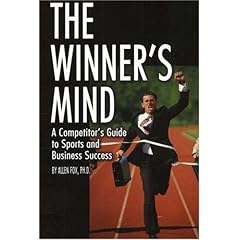
Book Review: The Winner's Mind

"The Winner's Mind" is a Winner
Is tennis primarily about "winning" or "having fun and learning"? Or both, or something else, or all the above? And how about matters beyond tennis, such as life itself?

Ultimately, that is, of course, probably for you to decide...

Meanwhile, this book, The Winner's Mind, by Allen Fox, Ph.D., and as stated by the publisher: "acknowledg[es] the conventional wisdom that "winning isn't everything," [but] takes the position that winning is still eminently preferable to losing and lays out a step-by-step plan for succeeding at any of life's endeavors." In short, while fun, learning and growth are indeed critical to our games and our life, this book goes on to present a well-thought argument about the value and reality of "winning" and a formula for most of us "non-champions" to better achieve it.

Fox, a psychologist and former successful business executive, is a former world-class tennis player, ranked No. 4 in the world, and a Quarterfinalist at Wimbledon, and later a coach at top-ranked Pepperdine University. In crisp and pointed language, rich with historical and recent examples, he lays out a case why we all have a genetic and learned need to compete and advance, and what factors typically block or restrict our path to "winning".

In a stunning example at the beginning of the book, he mentions a revealing study made of World War II fighter pilots which revealed that only about 5% of U.S. fighter pilots were responsible for shooting down enemy planes. What were the other 95% of our pilots doing? They were, of course, being shot down by the 5% of the enemy fighter pilots. The point? Only about 5% of us in the population possess an exceptional level of the "winner's" competitor's fire and formula.

He then goes on to study and outline the common characteristics of people he calls "habitual winners" in tennis and other walks of life...what do they share in common?

And in the heart of the book, Fox argues how all of the us, namely the rest of "non-champions", can model or employ many of these characteristics to better attain victory in our own games and lives.

This is a self-help book with a tennis flavor, but with valuable insights into ideas and strategies such as goal setting (short-term and long-term), the power of boundless energy - mental and physical, the assumption that all problems have solutions, and the value of constantly evaluating, adjusting and changing what we do.

Highly suggested.

Best, Gary

The Winner's Mind, Allen Fox, Ph.D.,(2005) on Amazon.com

Friday, December 4, 2009

"The First Beautiful Game"

The indoor sport of Real Tennis, also called court tennis, is often considered the forerunner to the sport we consider today's modern game of tennis. 

Two hundred years before soccer was dubbed "the beautiful game", real tennis or court tennis was called "the first beautiful game." It went by different names in different countries --- "royal tennis" in Australia; "jeu de paume" in France; and "court tennis" in the United States.

The scoring rules are very similar to modern tennis, with matches usually won at best of three sets. The ball is an old-style, dark cork-ball, but slightly heavier and less bouncier than a standard tennis ball. It's color was later changed to yellow for better optics. The rackets are made of wood, tightly strung and slightly bent, to make it easier to hit indoor corners and "slice" the ball.

There are about 42 courts worldwide that offer real tennis play today. The oldest real tennis court in the world opened in 1539 and is located in England - Falkland Palace (Fife) and still operational. One of the oldest real tennis courts in the United States opened in 1899 in Pennsylvania at the Racquet Club of Philadelphia.

Shakespeare first mentioned real tennis in his writings in Henry V, Act I, Scene II. King Henry responds to a gift of real tennis balls from the French Prince that he will use them to play a game that defeats France's royalty.

Later, the poet William Lathum compared life to a tennis court in Sick Verse, the Penquin Book:

The world I sample to a Tennis-court,
Where fate and fortune daily meet to play,
. . . 
All manner chance are Rackets, wherewithall
They bandie men, from wall to wall;
Some over Lyne, to honour and great place,
Some under Lyne, to infame and disgrace;

To read more about the origins and stories of real tennis, please refer to: The First Beautiful Game: Stories of Obsession in Real Tennis, Roman Krznaric, Oxford: Ronaldson Pub. (2006).
Meantime, let's get back to that court next chance we get, and practice that "First Beautiful Game"!

Thursday, December 3, 2009

History's Best Backhand: The One-Hander

Is the One-Hander or Two-Hander the Best Backhand?

The two handed backhand became popular in the era of Bjorn Borg, Jimmy Connors, Chris Evert and later Andre Agassi. 

And yes it is the dominant backhand version today at the professional, college and junior level. And it's certainly widely-noted for its power and stability.

But is it the best backhand style? That is for you  -- and ultimately history -- to decide. 

An argument can be made that the one-hander is likely history's best backhand -- if we look at all the best players in history who used it, including top pros today. 

The one-handed backhand is a gorgeous shot -- simple, versatile and powerful, and displays the user's supreme athleticism.

A few of the best one-handed backhands in history include:

Bill Tilden, Don Budge, Rod Laver, Ken Rosewall, Guillermo Vilas, Ivan Lendl, Pete Sampras, John McEnroe, Stefan Edberg, Boris Becker, Pancho Gonzales, Martina Navratilova, Steffi Graf. And in today's game, Roger Federer, Justine Henin and Richard Gasquet.

One hand or two hander? It's up to you. Either way, let's go hit that next backhand shot for a winner!

Best, Gary