Thursday, December 3, 2009

A theory on timing and control

I. Introduction
Watching Nikolay Davydenko's recent victory over Juan Del Potro in the Barclay's Masters Tournament in London and listening to Andre Agassi's recent Interview with 60 Minutes had me thinking about a theory on timing and control of the ball. 

II. The theory
What is my theory? It's this.

Timing and control, is seems to me, really about 3 things: the ball, the palm of your hitting hand, and the sweet spot of the racket head. And above all, the absolute unity and syncronizing of these 3 objects in the tennis stroke.


III. Davydenko and Agassi
What was seen at the Davydenko match and said at the Agassi inteview?

*It's about timing: Davydenko's masterful ability to take the ball on-the-rise, thereby short-circuiting the big-hitting power game of Delpo.

*It's about control: His artful short-angled shots to his opponent's sidelines, pulling Delpo out wide repeatedly.

*It's about the palm of the hand: Aggasi's re-telling of that famous story about his father's home-rigged ball machine "The Dragon" which spit out balls at over 100+ MPH at the young Agassi in training...his racket, hand, palm and ball probably became a single blur, and thus honed the extra-ordinary hand-eye coordination of the one of the best on-the-rise hitters in history.


IV. The assumptions
Now, let's look at the two assumptions of my theory just a bit closer: Only the racket head sweet spot touches the ball, and only the player's palm of hand touches the racket head sweet spot via the racket handle.


A. Only the racket head sweet spot properly contacts the ball
Bill Tilden, in his classic book How to Play Better Tennis (1950), put it this way, and it is still true today: "[The] all-important fact...is the head of the racquet and only the head of the racquet returns a ball in tennis."

Thus, since the very beginning, the only thing which properly touches the ball from the player in any stroke or rally is: the sweet spot of the racket head.

B. Only the palm of the hand is connected to the sweet spot via the racket handle
The sweet spot is located in the center of the racket head. The racket head is physically connected by a handle to the hand's palm. Thus, the palm of hand and only the palm of hand is in physical touch (indirectly) with the sweet spot.

Typically, the hand's palm is approximately 15 to 20 inches or so from the sweet spot. The challenge of the good timing, therefore, is to operate the stroke mechanic in a way so as to reduce that distance, in the player's mind-eye, down to zero.

V. Conclusion
Simply: The ball, the racket sweet spot and the palm of the hand must work in unison to achieve and maximize timing and control.

VI. Post Script: A few other points on timing made by other writers worth considering here:

1. The myth of watching the ball hit the racket strings - Vic Braden, in his book Mental Tennis explained that watching the tennis ball hit the racket strings is essentially impossible for the human eye. Based on his high speed filming and research with ophthalmologists, a ball is only on a racket string about 3 milliseconds, which is a time frame the human eye cannot record. In fact, Braden later clarified that the human eye begins to lose focus on moving objects within a 3 feet radius. Mental Tennis, Vic Braden, Little Brown (1993), Pages 180-182.

2. Keeping the head still and fixed on the contact zone throughout and after the stroke - This then becomes the actual purpose of "watching the ball". The head, which is the heaviest part of the human body, is kept quiet, and thus removed it from the equation so as to produce a balanced and stable stroke mechanic. Research has consistently shown that top level players keep their upper body, especially head, absolutely still on the their strokes. Watch how long, for example, Federer's head stays fixed on the contact point, even after the ball has left his racket.

3. Feeling "connected" to the racket head sweet spot, by not gripping the handle too tightly between the fingers, but pushing it directly onto the palm. Most players simply grip the handle much too tightly, and thus "feel" not the racket head sweet spot, but just the tenseness of their forearm. A critical component of timing: the player "feels" the literal weight of the racket head sweet spot as it moves towards the ball. In fact, many players use other techniques such as aiming the butt of the racket handle at the in-coming ball on their stroke, and making use of the non-dominant hand in the take-back, to help them achieve this "feel". "Timing and Feel of the Racket Head", Don Brosseau, www.tennisplayer.net

4. The crux movement in the on-the-rise stroke mechanic - Coiling the racket and sinking the body before the ball bounce, and then uncoiling and lifting before the ball reaches it's apex is the methodology of hitting on the rise. "Two Secrets of Timing", Scott Murphy, www.tennisplayer.net

5. Jeu de Paume - The original French name for tennis was "Jeu de Paume" (game of the palm). The fact that the very name of tennis is described with the palm of the hand implies the critical importance of hand timing.

6. Command of the racket head sweet spot is the master key to timing - Consider what Agassi recently commented about the World's Number One Player: What sets Federer apart from all the others is his phenomenal ability to control the racket head.

Best, Gary

Monday, November 23, 2009

Serve it up!


Some thoughts on the tennis serve
Most observers say that the most important shot in tennis is the serve. One report I read said that the serve (and return) can account for up to 65% of the points won in a match.

The serve historically was meant simply to start the point. As recently as the 70s and early 80s, champions such as Chris Evert and Jimmy Connors seemed to use the serve for that purpose more than any other. The story today is quite different, led by a school of big servers such as Ivo Karlovic, John Isner and of course Andy Roddick.

Now, it is primarily used, I think, to hit aces, service winners, or force weak replies and go on the offense. In fact, if a player does not try and use it for that purpose, it is probably a weakness or liability in their game.

*What causes the biggest problems to most players on the serve?
For me, the biggest problem with the serve, probably common to most recreational and club players most of the time, is that my motion is simply too tight and tense, and not loose and relaxed. More than anything else, the successful serve motion requires a loose and relaxed swing, the proverbial "spaghetti arm". Next issue for me, and probably many others, is simply losing control of the toss - simply too low or not enough out in front. The end result is too often the ball going into the net, or landing out wide, which means that the racket head on contact is too open facing the sky, or too closed facing the ground.

The successful serve is meant to be hit with racket head flat against ball on impact, and the left arm (or non-dominant arm) held up as long as possible, with the shoulders tilted to the sky at 60% or 70% angle or higher. "Serve-and-stretch", and also "serve-to-the-sky", as many instructors say. Too often, I drop my left arm too quickly, thus causing my shoulder and head to drop and the ball to fall into the net.

*How can common service problems be fixed?
A relaxation strategy - physical and mental. Think not about double faulting, missing the box long or throwing the ball into the net but about placement, spin and racket head drop. On the physical side, literally shake loose your shoulder, arm and hand. Stretch the low back. Deliberately hold the handle with a loose grip. Practice a lot of shadow swings to loosen up. Practice a lot of shadow tosses. If possible, try some practice serves from the service line, then from no-man's land, before practicing from the baseline. Focus on pronation "pops" - that pop noise when the ball smacks the middle of the racket. Keep the left arm up as long as possible and serve up to the sky...

The toss. The goal appears to be placing the ball consistently where you want it, and specifically at the point in the sky where your swing sports it's "strike zone". As Bill Tilden said in How to Play Better Tennis (1950), "You toss at your swing, you don't swing at your toss."

How do you keep the toss consistent at the same angle in front of you? Jack Kramer rejected the word "toss" the ball, and instead called it "place" the ball. To master the toss, Kramer once suggested that you place a handkerchief in an area about 2 feet in front of you and slightly to the right (if you are right-handed) - and practice until you can land 100 balls in a row on the handkerchief.

What about toss height? Roscoe Tanner is probably the most often mentioned who had a successful serve with a very short ball toss. He is very likely, though, an exception. Most instructors suggest tossing the ball up higher than the racket swing of your racket to get a little better rhythm and timing.

Should you hit the ball on its way up, at its peak or on its the way down?

It is probably very difficult for most players to hit the ball on its way up. The timing required for this is likely extra-ordinary. Bill Tilden used to do it and opponents said that it made the disguise and speed of his serve uncanny. Not easy for most of the rest of us.

Ellsworth Vines, regarded by experts as one of the best pure servers in history, said that by experimenting he found that he could get more power by hitting the ball on its way down from the toss. He thought that more power can be generated through forward thrust on a tossed ball moving downward than a motionless one at its peak. It certainly worked for Vines who served an average of 2 aces per service game.


Since the time of Vines and up to now, most instructors usually suggest hitting the ball on its way down for most players.

*What about a serving ritual or routine?
I think this is vital for most people to help with relaxation and rhythm. Many players bounce the ball several times before the serve, as I do, or have some other ritual. The ritual is also used to focus the mind and give a pause in the play. When a player misses the first serve, I think the ritual, and slowing things down a bit, is even more important to re-focus for the second serve. Too often, I see nervous and embarrassed servers launch into their second serve motion too quickly and just double-fault.

*What do you think about as you are about to serve?
I try and get a good balanced platform stance (the other popular stance is the pinpoint stance), and show my opponent a good "look" to my serve-to-come. Coaches say locate a target and visualize the ball going there. Think also about the type of serve contact (flat, slice, kick). I also try to focus on the depth of my racket drop - a deeper racket drop creates a longer "runway" to pick up power and spin. Many coaches call the deeper racket drop, the "buttscratch", and the long runway serve, the "sweep-and-serve".

Ideally, you might want to "jump into the serve" with deep knee bend, landing on your non-dominant foot, to increase power and spin, though this is considered an advanced athletic motion.

*Two recent interesting articles
I recently read 2 interesting articles on the serve - one discussed the number of serve targets available to a player and how to think about the service box, and the other about the types of service rhythms.

The author of the first article suggested that the service box should be divided into 3 parts - down the middle T, out wide and into the body. He also said that the type of serve contact - flat, slice and spin might be considered a "target" goal.

Let's take the deuce side. Since you have potentially 3 types of serves going to the 3 parts of the service box, you have 9 different targets (i.e. location of serve and type of serve).You have another 9 targets also on the Ad Side.

Thus, you have 18 targets, according to this writer.

I think that if most players can even hit half those 18 targets consistently with even just a little disguise, they will effectively disable most opponents up to 4.5, maybe even up to a 5.0. My opinion.

The author of the second article discussed the importance of rhythm and timing to the successful serve. He identified three (3) types of service rhythms most servers fall into and reviewed their checkpoints- the classic rhythm, the abbreviated rhythm and the staggered rhythm. Examples of classic (Federer, Lisa Raymond), abbreviated (Roddick, Nadal, Henin), staggered (Safina, Tsonga, V. Williams).

Take another look at the serves of these players on TV or You Tube, and see how they differ based on their descriptive titles and which style your serve most resembles.

[Thanks to "Understanding the Service Box", Paul Lockwood, Coach/Director, and "The Three Service Rhythms", Doug Eng Ed.D, Ph.D.]

*Is there a mental aspect to the serve?
From a recent ESPN article:
"As many point out, the mental component is key to the serve since it is the one stroke they have complete control over how they hit. It is also the most complex stroke, involving coordination between the racket arm, the ball-tossing arm and the legs, as well as explosive movement from a standing position. That leaves it more vulnerable to disruption."

See Why Can't the Women Serve?

*Does the serve affect the rest of your game?
From the same ESPN article:
"The impact of struggling on serve is not confined to the shot itself, observed Ana Ivanovic: "It was really frustrating, and it was affecting my whole game. I think it's not only case with me, it's with every player who has a big serve. And then all of a sudden if the serve is not coming, it affects your whole movement or your whole game."

*How would a new player learn the serve?
The short answer, of course, is practice-practice-practice. I would think that a new player might need to familiarize himself with the throwing motion itself, perhaps by literally throwing a football around on the court. I think there might be some value also to getting the new person familiar with the natural pronation motion of the arm during the serve, perhaps by watching the mechanics of the bullwhip in action.

There may also be a value for this new player to learn about "pronation pops" without worrying about trying the get the ball into the box. If, for example, they hit serves with "pop" against the back fence or hitting wall, it effectively takes the service box out of the equation.

*Final comments
I think that every sport has its "sexy" shot or play - in golf, the hole-in-one; in basketball, the slam-dunk; in football, the long-bomb touchdown. In tennis, I think it's the serve, that untouchable ace that players love to hit and everyone loves to watch...

May all your serves be aces!

Gary

A quick look at the awesome serve - silky-smooth and powerful - of one of history's best players, Pancho Gonzales.

Friday, November 20, 2009

The Rise of the Return . . .

The service return most recently was the special province and domain of champions such as Andre Agassi and Jimmy Connors, considered two of the greatest returners in history.

No longer.

Now, the return, together with the serve which was always considered the most important shot in tennis by most observers, has risen in importance in the game to equal the serve.

USA Today recently published some statistics to show that top level player rankings are best measured by a combination of BOTH successful service returns AND serves...

Article: Getting to the top in tennis, stats say, is all about the return (Sept. 10, 2009)

From the article:
"Last year, for instance, the most accurate statistical barometer for predicting a top-10 finish in the year-end rankings came in two return categories: points won returning first serve, and break points converted."

"Players used to attack," says 15-time major winner Roger Federer, who launched his record-breaking career in 1998. "Now they defend more. (The analysis) just confirms what the feeling is of everybody."


(Photo Credit USA Today)

Points to consider as players build their return game...

Best, Gary

Today's Tennis: The Constants Amidst the Changes

We know about all the changes in today's modern "power and topspin" game, such as changes in rackets, strings, technology, and the rise of the baseline game, the decline of serve-and-volley, prevalence of western-type grips and 2 handed backhands, etc.

What are the "constants" or constant factors that have not changed? What has remained the same since the days of say Tilden and Budge, Gonzales and Laver, Ashe and Connors, McEnroe and Borg, Lendl and Edberg?

Since these constant factors have not changed, aren't they critical for people learning and improving their game to consider, take into account, and analyze?

Some CONSTANT FACTORS that come to mind are:
*Size and dimensions of the court
*Size and dimensions of the net
* The size and dimensions of the ball
*The laws of physics
*Principle of moving forward aggressively and cutting off angles
*The idea of watching and tracking the ball
*Fundamental strategies such as "always change a losing game", "never change a winning game", etc.
*The basics of the mental game (I think), such as building mental toughness, etc.
*Even the scoring system remains essentially unchanged

One argument of some observers, which is relevant here, is that there are also "fundamentals" or fundamental principles of good tennis that have remained the same and unchanged over time, through eras and players...

Among these FUNDAMENTAL PRINCIPLES are:
*consistency and control as your base or platform
*use of non-dominant arm and hand to help create balance and to space one's self from the ball
*footwork, posture and balance (keeping weight half and half between both legs and feet, staying low, etc.)
*small steps vs. large steps in moving towards the ball
*serve posture: serve and stretch, i.e. keeping the non-dominant arm up after the toss
*hitting the ball cleanly into the racket head's "sweet spot"
*tennis as a "game of errors" - last person to hit the ball inside the court wins the point
*sustained and dynamic energy followed by rest and recovery


Players and eras change, equipment and technology improve, and indeed the game itself advances. Yet there may also be some "constant" factors and and "fundamental" principles in tennis which do not change but endure...

Food for thought. 

GOAT: Who's the greatest player of all time?

I. The Eternal Tennis Question
On this perennial question at the Sunday tea party, I read an article from Tennis Week Magazine, "Statistical Analysis of the Greatest Players", Nov. 2007 I thought was very interesting.


Statistical analysis of the greatest players of all time.

II. The Criteria
1. Career won-loss percentage
2. Best won-loss percentage for a five-year period
3. Career tournament titles
4. Tournament titles won in a best five-year period
5. Career percentage of tournaments won
6. Percentage of tournaments won in a best five-year period
7. Career Grand Slam titles
8. Slams won in a best five-year period
9. Career Grand Slam winning percentage
10. Percentage of Grand Slams won in a best five-year period

III. The Final Conclusion
RANK:
1. Rod Laver
2. Bjorn Borg and Bill Tilden (tie)
3. Roger Federer
4. Pancho Gonzalez
5. Ken Rosewall
6. Don Budge
7. Ivan Lendl
8. Jimmy Connors
9. Pete Sampras
10. John McEnroe
11. Jack Kramer

12. Ellsworth Vines
13. Fred Perry.


Best, Gary

Why Play Tennis? That Mad Crazy Thrill!

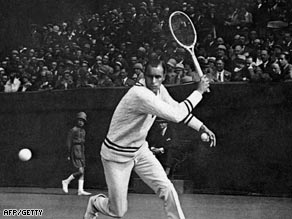
(Photo Credit AFP/Getty)

When asked why he loved tennis, Bill Tilden, the great champion from the 20's and probably the first tennis superstar, said it was that "that mad crazy thrill." 

"There is no sensation in the sporting world so thoroughly enjoyable to me as that when I meet a tennis ball just right in the very middle of my racquet and smack it, just right, where my opponent should be but is not."

*From Match Play and the Spin of the Ball, Originally published 1925. 


Best, Gary

Winning the Big Points.

Topic: Is not the nature of tennis that some points are "bigger" or more critical to win in a match or set than others? What are they and why? How can one maximize the chances and opportunities to win those big points?

A few months ago Tennis magazine suggested a slightly older book as still one of the best "overall" tennis books, and I picked it up. Total Tennis, Peter Burwash, Collier-Macmillan, 1989. It is an older book from the late 1980s.

For me, I got a lot out of this book, as much as the Mental Tennis book by Vic Braden on the mental side.

One of the points made in the book was that not every point in tennis is equal to every other point. The phrase "play one point at a time" assumes that each point is the same in importance. But you would not trade a king for a pawn in chess, or in tennis it seems.

A person can win a set 6-4, and still lose 40% of the points. A person can have just one break of serve, and win the set 6-4. In fact (it appears) that a person on paper can lose most of the points of a match and still win the match!

Since a tennis match is a game of physical and emotional momentum shifting back and forth, and it is impossible for anyone to maintain focused intensity throughout a match from start to finish, it's important to know which points to focus on to win.

For example, match point and set point are critical to win. If you never win a match point or set point, you never win.

Burwash says that the third point and the fifth point of every game are also critical to win. Concerning the third point of a game, say 15-15, there is a large difference between 15-30 and 30-15. If the third point is played at 30-0 or 0-30, there is a big difference between 40-0 and 0-40.

Similarly, the fifth point of a game, if played at 30-30, there is a big difference between 30-40 down, and 40-30 up.

I would add that a break point (up for you), and also game point (up for you) is critical to win.

Next, Burwash argues that the fifth game and the seventh game of a set is critical to win. The fifth game played at 2-2, the difference is 2-3 or 3-2. If fifth game is played at 3-1 or 1-3, the difference is 4-1 or 1-4.

The seventh game played at 3-3, the difference is 3-4 or 4-3. The seventh game played at 4-2 or 2-4 makes a big difference. It is now either 5-2 or 2-5.

The biggest decisive points of all are then: the third and fifth point of the seventh game. Burwash says that the champs almost always win those points, or at least know they need to.

Food for thought.

Best, Gary