Friday, August 12, 2022

Tennis can help change the world - for the better!


CONTENTS
I. Introduction: Tennis as "Just a Game" 
II. Advancing Equality and Equal Opportunity
1. Richard "Pancho" Gonzalez (Man with a Racket)
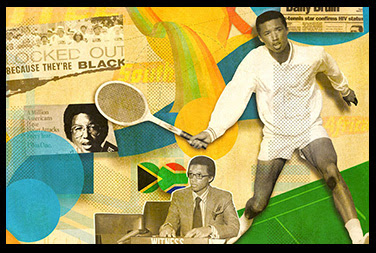
2. Arthur Ashe (Citizen of the World)
3. Billie Jean King (Queen of Tennis and Social Change)
III. Promoting Social Causes and Combatting Societal Problems
IV. Conclusion: Tennis as More than a Game

I. Introduction: Tennis as "Just a Game"

"It's just a game." 

These words are often said at matches and practices by those who contrast tennis with seemingly larger things in life. But on reflection, I suggest that this sells tennis short --- and that tennis represents much more than "just a game." 

Tennis is a shared emotional and visceral experience. It's played by people from all walks of life, in every age group, and at every level of play. Players and fans range from wealthy to poor, from elites to working class, from club VIPs to kids with homemade rackets. 

From the days when it was enjoyed almost exclusively by the privileged few in wealthy clubs in Western Europe, tennis has evolved into the second biggest global sport after soccer. Top players now come from all over the world, and passionate followers are found in hundreds of countries. And it serves to unite people and cultures at vast distances. 

Even more, tennis at its best operates as a platform to send powerful messages and help improve and elevate life. Let's look closer at how. 

Tennis can: 
*Advance equality and equal opportunity
*Promote social causes and combat societal problems 

II. Advancing Equality and Equal Opportunity 

Since it was first introduced in 1874 as "Lawn Tennis" by Major Walter Clopton Wingfield of Wales, tennis and its cumulative history as a modern sport has demonstrated at least one thing. 

Tennis is a global force for equality and equal opportunity in the world. 

Let's check the biographies of three (3) legendary American players, who by their successes on and off the court, indisputably advanced equality in their times. 

1. Richard "Pancho" Gonzalez (Man with a Racket)


"The great champions were always vicious competitors." 

Born into a relatively poor Latino family in the barrios of Los Angeles in 1928, the scrappy kid Richard "Pancho" Gonzalez picked up a racket and went on to change the nature of the sport in his era. 

In his day, tennis was considered an elite game. It was showcased exclusively in rich country clubs and enjoyed predominately by privileged white males. But as his tennis accomplishments grew, Gonzalez was invited to play at famed country clubs. 

They called him "Pancho" --- but it was a name he disliked because in those days it was often used as a slur for Mexican-Americans. Yet as fate would have it, it is the name history best remembers him by. 

Gonzalez years later revealed that throughout his career he had faced discrimination because of his heritage and social class. But he was never deterred, and always pushed forward. 

Gonzalez was an all-court player with a signature cannonball serve, and a superb net volley game. Gonzalez went on to build a history-making tennis career, winning 15 major singles championships, including 2 U.S. Open titles, in the pre-Open era. 

He was ranked World Number One for 9 consecutive years from 1952 to 1961, establishing himself as an indomitable competitor with a fierce temper. Gonzalez is often rated by historians as one of the greatest players of all time. 

But beyond his on-court accomplishments, Gonzalez was the first modern American player to break traditional tennis barriers of social class and color in his day. He gained wide public acceptance, and thus blazed a trail for what was possible for future minority tennis players and sports athletes. Gonzalez taught, coached and served as mentor to younger players, thus leaving an enduring legacy. 

Arthur Ashe, the great African-American champion whom Gonzalez helped teach and who himself battled discrimination, once remarked that Pancho Gonzalez "was the only idol I ever had." 

Gonzalez was inducted into the International Tennis Hall of Fame in 1968. Today, the Richard Pancho Gonzalez Youth Foundation carries on the work of developing tennis youth in his name. 

2. Arthur Ashe (Citizen of the World)


"Start where you are. Use what you have. Do what you can."

Born in 1943 into segregated Richmond, Virginia, the capitol of the old Confederacy, the skinny bright kid Arthur Ashe showed an early powerful flair for tennis. He developed his game and won a tennis scholarship to UCLA, and led them to an NCAA Championship in 1965, while earning a B.A. in Business Administration. 

Ashe went on to turn professional and win a multitude of titles, and become one of the most prominent tennis players of his time. Overcoming discrimination throughout his life, Ashe became the first African-American male to win the U.S. Open, Wimbledon and the Australian Open, and play for the winning U.S. Davis Cup team in the 60s and 70s. Millions around the world looked up to him as a global icon, rivaling Muhammad Ali and later Michael Jordan. 

Utilizing his tennis success and prominence as a platform, Ashe advocated for what he believed as rightful causes. In fact, his path became a blueprint for today's modern activist athlete. Ashe pushed for better pay for players, better opportunities for African-American youth, and helped form what is today the Association of Tennis Professionals (ATP). 

Later when he was denied a visa to play in South Africa's tennis tour, he took up the cause of the anti-apartheid movement. And after his playing career ended, Ashe contracted HIV from a surgery blood transfusion, but decided to use the opportunity to fight for AIDS research and funding. 

Always the mentor, Ashe taught tennis, and inspired youth and children. Today, a wide array of youth development programs and scholarships around the country leave his lasting mark. 

Ashe passed away in 1993 at the age of 49. That same year 1993, he was posthumously awarded the Presidential Medal of Freedom, our nation's highest civilian honor, for his work as activist, humanitarian and player. Today, the U.S. Open stadium is named in his honor, and each year opens with the Arthur Ashe Kids Day to carry on his legacy. 

3. Billie Jean King (Queen of Tennis and Social Change)


"I wanted to use tennis for social change. My whole life has been about equal rights and opportunities. For me, it really goes back the health of mind, body and soul." 

As the 11 year-old daughter of a fireman in California in the 50s, Billie Jean King picked up a racket that she bought for $8 from chores --- and declared that she would be the number one player in the world one day. 

She went on to do just that, and in the process win 39 major titles in the 60s and 70s: 12 Grand Slam singles titles, 16 womens doubles titles, and 11 mixed doubles titles. She also helped win 7 Federation Cup titles, the premier international women's tour championship. 

From her early playing days in the pre-Open era, King fought for pay equity for women players. She heavily criticized the United States Lawn Tennis Association (USLTA) in 1967 for breeding an elitist system by offering top players cash under the table to play tournaments. Her voice was instrumental in helping to professionalize and upgrade tournament play in the Open era. 

She sought to elevate women's tennis in 1973 by founding what is today the Womens Tennis Association (WTA). The next year 1974, she co-founded the mixed doubles league now known as World Team Tennis (WTT). She was named its first commissioner, and thus became the first prominent woman commissioner in professional sports. 

King might best be remembered today by many fans for her publicity match in 1973 with the 55 year-old Bobby Riggs at the Houston Astrodome dubbed the "Battle of the Sexes." She won in 3 sets before 50 million U.S. viewers and 90 million worldwide. King's victory was then considered a touchstone in public acceptance of women's tennis. 

King later remarked on the match's pivotal nature: "I thought that it would set us [women's tennis] back 50 years if I didn't win that match." The contest was later showcased in the 2017 movie "Battle of the Sexes", starring Emma Stone. 

In 1981, King publicly came out as a lesbian, becoming the first prominent professional athlete to do so. She began speaking out for the LGBTQ community, and for their rights and acceptance. King built a lasting friendship with gay music superstar Elton John. And together they raised visibility and money for both AIDS-related causes and LGBTQ programs to reduce stigma and suicide. 

Throughout her career and life, King championed not only women's equality but also LGBTQ rights and dignity, with her tennis, her voice and her courage. She was awarded the Presidential Medal of Freedom in 2009, and the French Legion of Honor Award in 2022. The prestigious Federation Cup was re-named the Billie Jean King Cup in 2020. 

Today, the U.S. Open is played each year --- on equal terms for men, women and LGBTQ --- at the re-dedicated Billie Jean King Tennis Center. 

III. Promoting Social Causes and Combatting Societal Problems 

Building on the trailblazing examples of Gonzalez, Ashe and King, tennis has evolved into a new phenomenon. Today, players often use their tennis voice and platform to help serve as a vehicle for social change. 

One example is Serena Williams, 23 time Grand Slam champion, who has consistently supported the Black Lives Matter (BLM) movement which seeks to uplift the lives of young African-American men and others. 

In October 2015, Serena wrote: "So to those of you involved in equality movements such as BLM, I say this: Keep it up! We can keep working even more to  increase equality." 

Today, the Serena Ventures Fund offers more than $100 million in venture capital to support qualifying minority and women start-up businesses and help level the playing field. 

Along those lines, 4 time Grand Slam champion Naomi Osaka at the 2020 U.S. Open highlighted episodes of recent racial injustice. She wore Covid masks showcasing the names of George Floyd, Breonna Taylor and others. Osaka commented: "I'm a vessel to spread awareness." And she carried that message long after she won the championship that year. 

Moving on higher, other Global Challenges such as addressing Climate Change and standing up for Peace and against War have been championed by many players and groups in the tennis community. 

For instance, Novak Djokovic, Dominic Thiem and many others have voiced and warned about the issue of Climate Change, the accelerating danger to our planet from extreme weather arising from carbon emissions. 

Djokovic, and the four Grand Slam Championships, have supported various efforts to combat climate change, including the U.N.'s "Sports for Climate Change Action". This global program advocates an environmentally-friendly lifestyle, in a bold effort to save the Earth for the next generation. 

Meanwhile, peace and war issues became urgent after the Russian invasion into Ukraine in February 2022. World Number one Daniil Medvedev of Russia stood up for Peace and against violent conflict, explaining that "tennis sometimes is not that important" and "by being a tennis player, I want to promote peace all over the world." 

World Number five and fellow Russian Andrey Rublev added his voice to the Anti-War cause and remarked: "You realize how important it is to have peace in the world and to respect each other no matter what and to be united." 

Beyond simply voicing causes, the tennis community collectively has done even more: it has raised money, recruited resources and helped build solutions to societal problems. For example, after the Indian Ocean Tsunami in 2005, the ATP, WTA and others rallied to raise funds for disaster relief. Players auctioned off signed rackets, donated part of their winnings and and staged charity matches. 

The same happened again many times such as after the disasters of: the Japan Earthquake in 2011, the Australian Wildfires in early 2020, the Global Pandemic in 2020-21, and the Ukraine-Russia war of 2022. In this way and over the years, the tennis community has secured millions of dollars and other massive disaster assistance after tragedy. 

Today, the tennis world is working on forward-thinking social goals such as promoting youth education and building schools, thus bettering society for the next generation. 

Among the plethora of charitable organizations doing life-changing work are: the Andre Agassi Foundation, the Roger Federer Foundation, the Rafa Nadal Foundation, and the Novak Djokovic Foundation. Together, tennis-related groups have raised millions of dollars to advance the education and lives of countless youth and children around the world. 


IV. Conclusion: Tennis as a More than a Game

Just a game? No, it's much more. In a myriad of ways and over many decades, tennis has contributed something far more profound than merely the score of the match or the four corners of the court. 

By advancing equality and equal opportunity, promoting social causes, and combatting global challenges with funds and resources, tennis --- and its players, fans and supporters --- help change the world for the better! 

Monday, July 11, 2022

Tennis Quote of the Day: Professionalism and Preparation

The players who approach the game with professionalism, preparation, precision, productive chores and thoroughness will always get their chances and rewards.

Novak Djokovic, 2022 Wimbledon Champion, paraphrased from his Semi-Final Press Conference on July 08, 2022

Wimbledon 2022: * Parade of Champions * Legendary Wimbledon Champions Return to Centre Court

Wimbledon 2022: Novak Djokovic Wins 7th Championship and 21st Grand Slam Title (Mens Singles)

Wimbledon 2022: Elena Rybakina Wins First Championship (Ladies Singles)

Monday, July 4, 2022

Why is Tennis Timeless?

“Tennis is an amazing teaching tool. The game itself is great, but the life lessons it can impart are far more valuable: discipline, time management, problem-solving, critical thinking, independence, self-reliance, developing relationships with others.” 

- Tracy Austin, U.S. Open Champion, World No. 1

I started this Blog many years ago with a simple idea 
to help show that tennis is timeless, and that it reflects lessons for sports, business, school and life itself.

Shakespeare wrote the immortal words: “All the world’s a stage, and the men and women merely players.” And the same is true for tennis.

Tennis is a stage – a platform – to learn, practice, develop, strategize, execute, manage pressure, solve problems.

Consider that many on-court skills carry over and apply to many other aspects of life's activities: balance, relaxation, rhythm, energy, timing, control, focus, passion, purpose, mental strength.

But beyond carry-over skills and life lessons, I believe that tennis is timeless for yet another and more profound reason - it is a metaphor for life itself, and the human condition. And as long as we are all around, I believe that tennis will endure.

Andre Agassi, Eight-time Grand Slam Champion, reminded us that tennis literally uses the “language of life”: advantage, service, hold, play, break, fault, love.

But even more, Agassi went on to remark: “Every match is a life in miniature . . . any hour can be our finest. Or our darkest. It’s our choice.”

The tennis court is thus like life’s canvas – reflecting fierce battles, mighty challenges, true accomplishments, ignominious defeats and magnificent victories.

And showcasing the whole range of human passions – courage, fear, despair, surrender, indomitable fighting spirit, hope and much more.

As examples, let’s look at three (3) professional matches which reflect the sport as its best, and which exhibit its human drama and lessons.

1. Wimbledon 1979 Championship Final: Arthur Ashe (USA) def. Jimmy Connors (USA), 6-1, 6-1, 5-7, 6-4

Timeless Lesson: Strategy meets execution to produce ultimate victory

Few contests reach the legendary and epochal status in any sport as this match. Almost five decades later, many regard this match as the tennis equal of Muhammad Ali’s “Rope-a-Dope” triumph over World Champion George Foreman in their "Rumble-in-the-Jungle" in 1974.

Coming into the match, the heavily-favored and youthful Jimmy Connors was 22 years-old and in his prime. Connors was the defending Wimbledon Champion and World No. 1, and playing some of his best tennis. Arthur Ashe was the sentimental fan favorite but, at age 32, nearing the twilight of his distinguished career. And he had been soundly defeated by Connors a few months earlier in Johannesburg at the South Africa Championships. Most analysts rated Ashe’s prospects for victory quite low.

Ashe and his team developed a three part strategy to counter-act the power-hitting counterpunching game of Connors: 1. Slow the pace to the Connors forehand, with chip and dink shots, to offset his power game; 2. Hit balls shorter to bring Connors into the net where his game was weaker; 3. Lob often over the rushing Connors coming to net. The challenge was to stay focused and execute.

It worked magnificently. Ashe jumped out to a big lead in the first two sets, 6-1, 6-1. Connors fought back viciously in a tight and tense third set, 7-5. But in a close fourth set, Ashe re-doubled  his efforts at off-pace shots and lobs, and finally prevailed 6-4, and won the match. 

Courageous execution of a thoughtful strategy paid off in a Wimbledon Championship title. Ashe became the first African-American man to win Wimbledon. 

2. Australian Open 2010 Semi-Final: Marat Safin (RUS) def. Roger Federer (SUI), 5-7, 6-4, 5-7, 7-6 (6), 9-7


Timeless Lessons: Respect, not awe, for a superior opponent; Intentionality behind every shot; belief in your ultimate victory

17,000+ fans began assembling for the highly-anticipated semi-final match between two tennis giants at AO 2010. They and millions of world-wide viewers on television were to be treated to a blockbuster 4 ½ hour thriller - featuring world-class shot-making, dogged fighting spirit and suspenseful swings of momentum until the final point.

Marat Safin, former World Number 1 and 2000 U.S. Open Champion faced the seemingly invincible Roger Federer, World Number 1 and 4-time Grand Slam Champion on a 26 match winning streak. Safin lost a tight first set, and then fought back to win the second set and level the match. The pressure did not let up in tense third and fourth sets, with Federer raising his play level and taking the third set. Safin followed by finding new belief in his game and capturing the fourth set in a nailbiter tiebreak.

The fifth set was a battle royal which extended into overtime games. Every point was a titanic struggle as each player would punish any weak shot to end the point. Both players exchanged magnificent forehands and backhands. Safin found a way to elevate his game to its apex, and moved into the lead earning multiple match points. Federer, serving to stay in the match at 8-7 for Safin, showed cracks and fell behind. He valiantly fought off numerous match points but fell short. By breaking serve, Safin closed out the match at 9-7 in the fifth.

What can be learned? Safin’s play and methods illustrate lessons for us all. Despite Safin’s monster serve and powerful forehands, Federer took control early with an arsenal of shots, including baseline winners, drop shots and volleys. At times, Federer’s shot-making was beyond sublime and a thing of beauty to watch. But Safin remained unfazed. He held on and his power game eventually took hold. Commentator Patrick McEnroe observed that Safin’s attitude towards Federer was the right one: “respect” for each of his opponent’s shots, but not unbridled “awe” of the person himself, for that might intimidate you into a loss. 

Each shot executed by Safin plainly had great intention and purpose behind it, regardless of whether he won or lost the point. Throughout the match, Safin in his mind never surrendered, despite coming from behind for most of the match against an apparently superior opponent with a better record. His belief in ultimate victory was on clear display – and was pivotal and decisive for his win.

3. 
Wimbledon 2010 First Round: John Isner (USA) def. Nicolas Mahut (FRA), 6-4, 3-6, 6-7, 7-6, 70-68

Timeless Lessons: The indomitable heights of the human spirit, and the limits of human endurance

Wimbledon 2010 began as it always does - with global excitement and anticipation. John Isner and Nicolas Mahut were assigned to Court 18 at the All England Club for their First Round match.  Little did they or anyone suspect that theirs would showcase a match for the ages. It became the longest match in tennis history, spanning 11 hours and 5 minutes, stretched out over 3 days.

Isner was the young big serving American power hitter, and Mahut the fierce French doubles champion specialist. They played a close match through four sets, trading sets to reach a final fifth set. But because of loss of natural light, play had to be suspended until the next day for what became their towering fifth set. Wimbledon at that time did not recognize a fifth set tiebreak. So the players were called on to simply play on  - until one player or the other won the fifth set by two games – and thus the match.

In the fifth set, each player held their serve – and kept holding it. The score reached 6 all, then 7 all, then 8 all. And then it went on and on and on, moving into the 20s, 30s, 40s, 50s and then 60s, with no end in seeming sight. The commentators, fans and worldwide viewers were stupefied. In fact, the electronic scoreboard itself stopped working at 47-47, and had to be re-programmed. And due to loss of natural light by evening, play had to be suspended and resumed the following day. All told, each player held serve an incredible 168 consecutive games and hit over 100 aces.

Neither player gave up or gave in. They reached their physical exhaustion point, and then went beyond. Finally, on the third day, Isner held serve in the 137th game of the set, at 69-68. Mahut valiantly fought to hold serve on his game but finally fell short. Isner broke serve at 70-68. And closed out the longest ever tennis match. Today, a plaque hangs at Court 18 to honor both players, their monumental effort and the history-making match.

What was shown on those 3 days on Court 18 by Isner and Mahut was far more than a tennis match or sporting contest. What was showcased was the indomitable heights of the human spirt, and the limits of human endurance.

These timeless matches have stood the test of time, more for what they taught us than the results.

They - and many others at all levels of play and over the years and across the generations - undeniably illustrate an enduring truth: Tennis is timeless!