 As a tennis history buff, I have always believed that a good tennis player and fan should know something about the history of the game. This includes the great champions and matches of the past because they helped to lay the foundation for the modern game that we see today.
I recently read this masterful, well-researched and highly-praised book on a riveting period of tennis and world history - the 1937 Davis Cup semi-final match played at Wimbledon Centre Court between Germany and the United States, as the world prepared for war. Here's my review.
If people find this post useful and interesting, I may post more reviews of tennis history books here in the future.
Thanks for reading!
Gary
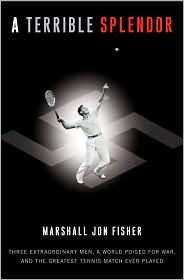
A Terrible Splendor: Three Extraordinary Men, A World Poised for War, and the Greatest Tennis Match Ever Played. Marshall Jon Fisher, Crown Publishers (April 2009). 321 Pages, 6 Chapters, 8 Pages of Black and White Photos.
(*The book's title comes from a quote from Thomas Carlyle about "Fate [which] envelopes and overshadows...[against which] human will appears but like flashes [of] a brief and terrible splendor...")
Before Federer and Nadal, before Sampras and Agassi, before Borg and McEnroe, the greatest tennis match of all, argues the book's author Marshall Jon Fisher was probably the singles match of the 1937 Davis Cup semi-final played at Wimbledon seven decades ago between the great Don Budge for the USA (ranked number one in the world at that time), and Baron Gottfried von Cramm for Germany (ranked number two).
Photo of Budge and von Cramm (Credit wsj.net):

The greatness of the match was based on more than pure tennis (though the tennis was indeed extraordinary), but also the backdrop of impending world war and the high stakes for all, especially von Cramm.
This match was a five set thriller before a raucous crowd on the edge of their seats. It ended only after five match points in the fifth set, culminating with a spectacular running forehand winner around the netpost, and after both men were exhausted and tested to their ultimate limits. One man was playing for the honor of his country - Budge. The other, Von Cramm, was literally playing for his life (as he was targeted by the Nazi regime in his home country for alleged offenses, and only his victory on the tennis court assured him safety.) In that sense, the match became a metaphor for the poignancy of the human battle and, in the words of the publisher, ultimately the "triumph of the human spirit".
Against it all, Fisher also writes beautifully about the rising drums of war across Europe and the world, interweaving the Budge-von Cramm match with the story of a world on the brink of global conflict.
The three extraordinary men of the book's title are: Budge and von Cramm, of course, and the third man - Bill Tilden, the great US tennis superstar and champion of the 20s. Fisher makes many insights into their lives and inter-relationships, traces their seminal tennis contributions and even touches on their personal demons.
Budge and von Cramm were good friends on and off the court, who genuinely liked each other. Budge and Tilden naturally had the greatest respect for each other and their respective abilities. Tilden said of Budge in a comment published later: "I consider him the finest player, 365 days a year, who ever lived." Tilden was a visitor many times to Germany and, in an interesting twist, unofficially coached the German Davis Cup team, including von Cramm and was rooting for him at the Davis Cup match, to the obvious dismay of American fans.
Bill Tilden
The first great tennis superstar, who transformed the sport from a gentile country club pastime to an arena for world-class athletes where winning was the ultimate goal and aim. Tilden in his prime simply was tennis. As sports writer Frank Deford wrote: "It was Tilden and tennis, in that order." From 1920 to 1926, Tilden never lost a match of any consequence, a record unequaled even to now. He won 10 lifetime major championships. He was also a talented writer and a brilliant student of the game. His 1925 classic book Match Play and the Spin of the Ball was studied by generations of tennis students. Consider what he wrote in his book about the "all-court player", almost a premonition about the game's future:
"What is the future of the tennis game? ... As one of the champions of today, I see vistas of progress ahead, of which I glimpse only a bit, but which the champions of tomorrow will have explored and developed. Where are these lanes of progress? Not from the backcourt. Not from the net. It is rather in the use of the forecourt for sharp angled shots, in the use of the mid-court volley, the half volley and rising bounce shots, that future progress lies. Every player who desires to succeed in the future must equip himself with every shot in tennis and then strive to explore the mysteries of the forecourt."
And Tilden was a consummate showman and entertainer. And he lived a flamboyant and extravagant lifestyle. He was famous for a reputedly 150MPH cannonball serve - with the wood rackets of old. Witnesses at matches, including Gene Mako, recalled that he could take 4 tennis balls in one hand - one between each finger and thumb and serve up 4 aces on command!
Tilden boasted a long career, playing on the pro tour well into his 40s and even 50s. In his late 40s, when he once beat Budge on the pro tour, Budge remarked that Tilden taught him a lesson, playing "the greatest tennis I have ever seen." At 53, Tilden could beat much younger stars Fred Perry and Bobby Riggs. It was said he could still be the best in the world for one set. "All they can do is beat him", wrote columnist Al Laney, "they cannot ever be his equal."
In 1950, a AP Sports Writers poll, without any real dissent, voted Bill Tilden the greatest player of the half-century.
(Oddly enough, Tilden shares a birthday with me - February 10, and comes from the same hometown - Philadelphia. I have even played at the Germantown Cricket Club in Philadelphia where he learned to play.)
Tilden sadly carried a dark secret from the public until the end of his days. He was a homosexual, and was charged late in his life of corrupting teenage boys. He was ostracized in public but always his tennis accomplishments were honored. He died of a heart attack in his hotel room at the age of 60.
Don Budge
Budge was the skinny, red-haired kid from Oakland, California, son of a truck driver, who learned the game at Bushrod public court. Later, he justifiably became "Mr. Tennis", literally inventing the "Grand Slam" by intentionally planning and winning all four majors in 1938. (In Budge's day, a sea journey to Australia to compete in their Open was 22 days.)
Pancho Segura once joked that Budge was so confident in his ability on the court that if you were his opponent, he was saying to you: "You can be my ballboy". And for good reason. His powerful backhand often hit on the rise with devastating consistency is even today considered one of the greatest in the game. Indeed, Budge's "unassailable package of power and consistency" is still viewed by many as "the finest ever", even seven decades later. In 1937-1938, he won 92 matches, 14 straight tournaments, including all the majors and 10 Davis Cup matches. He was voted by the press in 1937 and 1938 as the best American athlete.
Budge became a Hall of Famer in 1964 and retired in Eastern Pennsylvania. He died in a car accident in 1999.
Gottfried von Cramm
von Cramm was the tall, blond, green-eyed, impeccably groomed, German aristocrat with the title Baron, son of a lawyer and military officer. He was very popular and well-liked in tennis for his gentlemanly conduct and fair play. Unfortunately, he rose to prominence when the Nazi party came to power in Germany. They wanted to promote him as an example of Aryan superiority, but he refused to be used as a propaganda tool.
von Cramm was being watched by Nazi officials for this reason and others. He had married his childhood sweetheart, who was part Jewish. And there were also rumors that von Cramm was also a homosexual, a grave offense in Nazi Germany typically calling for imprisonment and punishment in a concentration camp. von Cramm was reportedly assured that as long as he kept winning at tennis, no harm would come to him.
Before the Davis Cup match with Budge, von Cramm had won the French Open titles twice, made the finals of Wimbledon two weeks earlier, and rose to number 2 in the world. Tilden had agreed to unofficially coach the German team and von Cramm, and greatly sharpened his backhand for the match.
In the years after the match, von Cramm was eventually arrested and imprisoned for the morals charge of homosexuality, and banned from tennis. He was also later drafted and served in the German Army on the Eastern front. After the war and many letters of protest from tennis fans around the world, he returned to play tennis and Wimbledon in the 1950s. He died in a car accident in Cairo, Egypt in 1976.
The Davis Cup Singles Match: Budge v. von Cramm
The Davis Cup matches were a major sporting event in tennis in 1937, closely followed around the world.
There were unconfirmed reports that just minutes before the match, von Cramm got a call from Hitler, and that he looked pale and deadly serious, answering with "Yes, mine Fuhrer."
The match itself was a five set spectator's marvel, with shot after shot thrilling the raucous crowd who rewarded a particularly brilliant point with an entire minute of applause.
von Cramm, serious and methodical and under Tilden's tutelage, took the first two sets, 8-6, 7-5 with an onslaught of net volleys and groundstrokes deep and hard to Budge's baseline, which were "like a barrage of leaden bombs." Budge who, according to Alister Cooke, played "crazy and inspired tennis", fought back by doggedly moving into net himself - intercepting von Cramm's deep shots at mid-court, hitting volleys from "no-man's land" on the way in, and took the next two sets, 6-4, 6-2.
One writer described the tennis as "winners hit off of balls which themselves appeared to be certain winners". James Thurber wrote that the level of play was an "inspired brilliance, amounting to almost physical genius..." Walter Pate declared years later "No man living or dead, could have beaten either man that day."
In the final set, to Budge's dismay, von Cramm pulled out to a 4-1 lead. Budge re-grouped and stormed back to a 6-6 tie. Point after point late into the fifth set became an epic duel, a "heroic and sustained" effort "with such gorgeous shots." It all ended at 8-6 in the fifth, after five match points, on a screaming running forehand winner to the crowd's thunderous cheers.
I won't reveal here who won but you're welcome to look it up. The important point is that both men, tested to the ultimate, hugged each other after the match, genuinely happy for each other's play - as the Centre Court inscription says - "meeting triumph and disaster and treating those two imposters the same."